30 april 2026
Can students and teachers keep up with developments in AI?

Matthijs Timmermans
Beleidsmedewerker
Stel uw vraag
Meer informatie nodig? Stel uw vraag aan één van onze medewerkers

30 april 2026
Beleidsmedewerker
Meer informatie nodig? Stel uw vraag aan één van onze medewerkers
Artificial intelligence is reshaping higher education faster than most students and teachers can follow. Not because they are unwilling to engage, but because frameworks to use AI critically and responsibly have simply not kept up. The Erasmus+ project INFINITE set out to close that gap. A consortium of universities and organisations from five European countries developed tools and training to help higher education staff and students navigate the AI-landscape thoughtfully. Neth-ER spoke with Francisco José Castillo Hernández and Andreea Ioana Sburlea, both Assistant Professors at the University of Groningen, about what INFINITE has achieved, what it reveals, and why European collaboration was essential in getting it right.


The INFINITE project launched in 2023, just as generative AI tools like ChatGPT entered university classrooms, fundamentally changing how we learn and teach. For many teachers and students, the arrival of these tools created as much confusion as opportunity. "It became clear from the literature that teachers and students were confused," says Francisco Castillo Hernández." People needed training on how to use these tools with real criteria in mind - ethically and critically." This urgency is echoed at the European level: the AI Act requires AI literacy for all users and providers but offers little guidance on how to achieve it in practice. INFINITE aims to bridge that gap. Crucially, the project takes a broad view of what AI literacy means. As Andreea Sburlea underlines, generative AI is only one part of a much larger field, and ChatGPT is just a small part of it. INFINITE therefore set out to equip participants with the conceptual foundations to understand and evaluate AI tools across contexts, not just the most visible ones.
Over the course of the project, the European consortium developed three core outputs. The first is an interactive AI Literacy Toolkit, including a theoretical framework for AI use in education, a repository of 35 best-case studies, a readiness checklist, and practical guidelines for critical analysis. The second is the AI Digital Hub, an online platform bringing together tutorials, tool repositories, and an observatory tracking developments in the AI landscape, including regulatory frameworks such as the AI Act. The third output is a professional development programme focusing on AI literacy, designed for teachers and students in higher education, piloted at partner institutions across five countries.
The pilot programme showed that both teachers and students shifted toward a more critical approach to AI. But the team is honest about its limitations. “In a few months, it is impossible to fully develop AI literacy,” says Castillo. “If we really want teachers and students to use it in a critical and ethical way, we need much more time.” The programme’s real value, the team argues, lies in its function as a trigger for deeper, meaningful and ongoing reflection. Short interventions change attitudes, but sustained engagement is needed to change practice.
One of the sharpest insights to emerge concerns the tension between the efficiency gains AI tools offer and the nature of learning itself. "This focus on effectiveness and efficiency is actually somewhat detrimental to learning," says Sburlea." Learning is a very different topic than being able to finish your assignments by the deadline." This prompts a broader question about the direction of educational investment. "We are spending a lot of money on AI development,” says Castillo.“ Perhaps this money could instead help us to have fewer students per classroom, which would also make teaching more tailored to each student's needs." INFINITE does not dismiss AI tools but insists the discourse must shift from uncritical adoption driven by productivity promises to a genuinely human-centred integration rooted in pedagogical purpose.
For Sburlea, equipping people early has consequences that reach far beyond the classroom. "If we are contributing at an early stage, this is going to ensure students become professionals with a stronger, more responsible relationship with AI." The project’s core message is one of structured preparedness: giving people a framework not only for how AI tools work today, but for the pace of change itself. "The models that existed three months ago are already outperformed by newer ones. With such a pace, people need to be able to update their skills and remain aware of the limitations these models carry."
The consortium’s diversity was a deliberate choice. "Even though we are Europeans, we have a lot of differences," says Castillo Hernández. "The needs of teachers in Greece or Cyprus are not the same as here in the Netherlands. This collaboration helped me to realise how different we are, and also how we can complement each other." That complementarity extends to expertise: Castillo Hernández brings a background in education and teacher training, while Sburlea approaches AI from neuroscience and human-centred intelligence. Regular communication with European colleagues kept the partnership on track across different working cultures, something Castillo describes as one of the most enriching aspects of working on EU-projects.
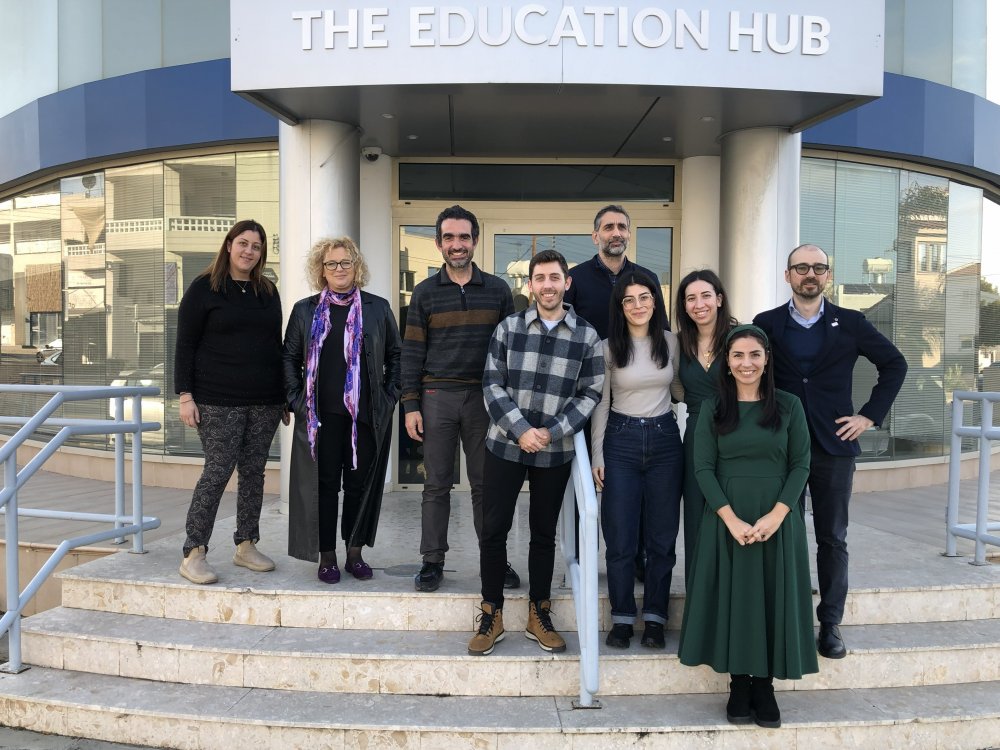

As the project approaches its close, each partner institution is organising national dissemination events. The concluding international conference takes place in April 2026 at the House of Connections, University Groningen, bringing together experts in AI and education to discuss the road ahead. All outputs are freely available for institutions across Europe. INFINITE will not single-handedly resolve the questions it raises. But it demonstrates what European cooperation can achieve. Building shared knowledge, bridging different contexts, and equipping educators and students to engage critically with one of the defining challenges of our time.

Francisco José Castillo Hernández is an Assistant Professor at the Centre for Learning and Teaching within the Faculty of Science and Engineering at the University of Groningen. He holds a PhD in Science Education from the University of Almeria, Spain. His research focuses on the design, implementation, and evaluation of teaching and learning materials, as well as the ethical and critical use of Artificial Intelligence in higher education environments. He has contributed as researcher and coordinator in projects funded by the European Union, including Erasmus+ and Horizon programmes. Francisco's work is part of an interdisciplinary team at the Centre for Learning and Teaching, focusing on educational innovation, professional development, and strengthening the connection between higher education and society through science communication and the responsible use of emerging technologies.

Andreea Ioana Sburlea is an Assistant Professor in Human-Centered Artificial Intelligence within the Faculty of Science and Engineering at the University of Groningen. She holds a PhD in Biomedical Engineering from the University of Zaragoza and the Polytechnic University of Catalonia, Spain. Her research spans brain-computer interfaces, machine learning for neural signal decoding, and the integration of AI in neurorehabilitation - alongside a strong focus on the ethical and human-centred use of AI in higher education. She has contributed to multiple EU-funded projects, including Horizon and Erasmus+ initiatives. Her work combines neuroscience, AI, and education, aiming to advance both human-centred technologies and responsible AI integration in teaching and learning.
How do we prepare young Europeans to work alongside robots and algorithms? Why should we measure radio waves with European partners? And how can medical institutions adopt artificial intelligence in line with GDPR? These are the sorts of questions we explore in our special article series, Knowledge Without Borders. Covering education, research, and innovation, Neth-ER tells stories from across the European knowledge sector showing the impact of European collaboration and EU funding.
Register now: Neth-ER Network Conference 2026
Concurrentiekracht en strategische autonomie opnieuw centraal in State of the Union
Nieuwe Innovatieverordening moet aanbesteding en financiering van Europese innovaties versnellen en versterken
Neth-ER publishes recommendations for dual-use R&I in Horizon Europe 2028–2034